I Filed a $50,000 Lawsuit Against the Biker Who Crashed Into My Car
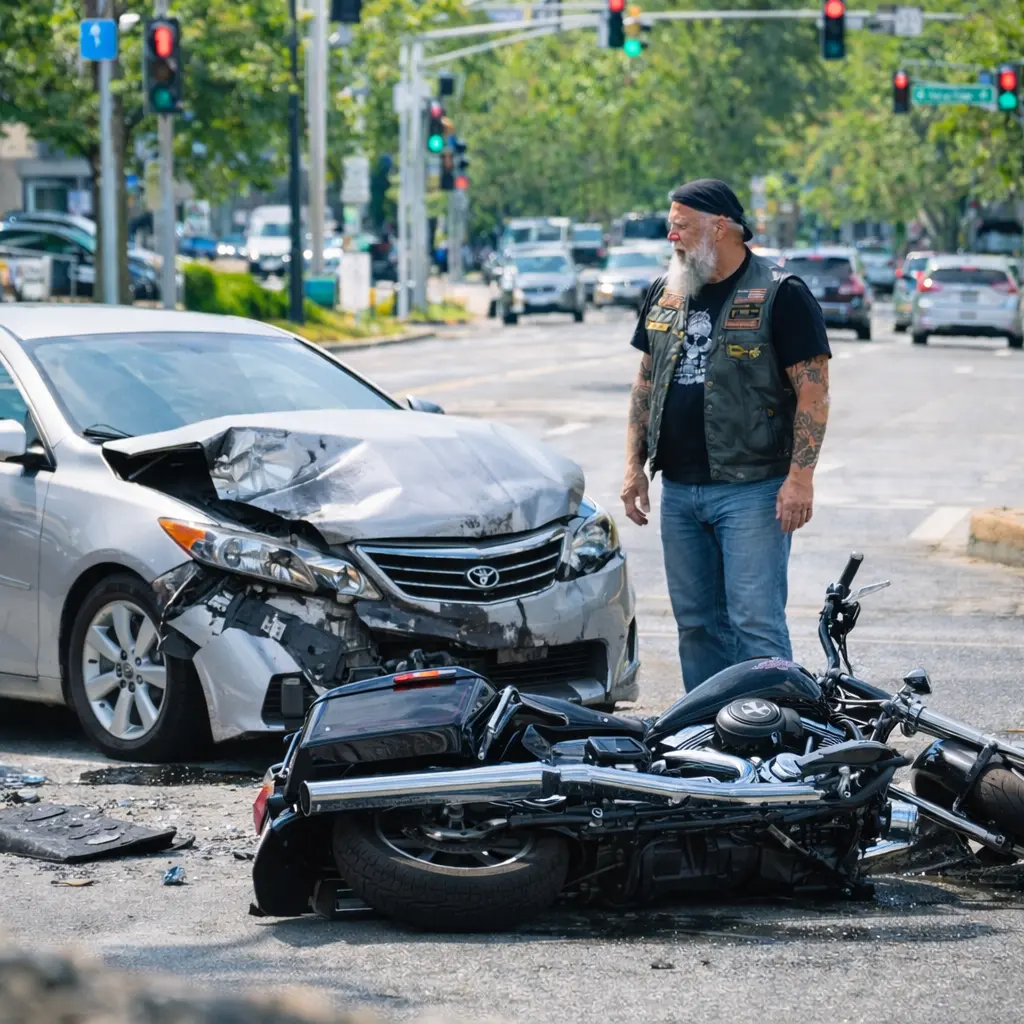
I filed a lawsuit against the biker who hit my car for $50,000. My lawyer said the case was a slam dunk—easy money. According to him, the biker was clearly at fault.
What I didn’t realize was who I was actually suing until the day I walked into the courtroom.
The accident happened on a Tuesday in March. I was sitting at a red light when a motorcycle bumped into the back of my car. It wasn’t a huge crash, but it was strong enough to crack my bumper.
By the time I stepped out of the car, the biker had already gotten off his motorcycle. He looked like he was around sixty, wearing a leather vest with a gray beard. His expression was filled with worry.
“I’m so sorry,” he said right away. “Are you okay?”
“I’m fine,” I replied. “But my car isn’t.”
“I’ll pay for it,” he said quickly. “Whatever it costs.”
The police arrived soon after. The biker—Frank Morrison—admitted it was his fault. He handed over his insurance information and apologized several more times before we left.
That evening my neck started to ache. By the next morning I could barely move it. The doctor said it was whiplash.
So I called my lawyer.
He told me, “You can get a lot more than just the cost of fixing the car. We’re talking fifty thousand dollars. Pain and suffering. Lost wages.”
Fifty thousand.
I thought about my credit card bills. My student loans.
“Alright,” I told him. “Let’s do it.”
Frank Morrison didn’t settle. His lawyer kept asking for delays, dragging everything out. But I wasn’t planning to back down. I had medical bills. I believed I deserved compensation.
Finally, the court date arrived.
June 15th.
I showed up in a suit. Morrison was already there sitting beside his attorney. He looked thinner than I remembered, and his hands trembled slightly.
Then the back door of the courtroom opened.
About twenty people walked in together.
Every one of them wore the same t-shirt. On the front was a photo of a little girl, maybe seven years old, smiling wide with a missing front tooth.
Under the picture were the words:
“SARAH’S RIDE – In Memory of Our Angel.”
Something cold twisted in my stomach.
My lawyer began presenting our case. Photos of the car. Medical records.
“The defendant acted negligently,” he said confidently. “My client deserves full compensation.”
Then Morrison’s lawyer stood up.
“Your Honor,” he said calmly, “my client does not dispute fault. He already paid for the damage to the vehicle. However, he cannot afford fifty thousand dollars.”
My lawyer responded sharply. “Then perhaps he should have been more careful.”
Morrison’s attorney glanced back at the people wearing those shirts.
“Your Honor, may I provide some context?”
The judge nodded. “Go ahead.”
I was still thinking about the money when the lawyer said:
“Three weeks before this accident, my client’s seven-year-old granddaughter was killed by a distracted driver. The driver was texting, ran a red light, and struck Sarah Morrison while she was crossing the street.”
The entire courtroom went silent.
“My client has barely been functioning since her death,” he continued. “He’s attending grief counseling and taking medication. On the day of this accident, he had just come from his granddaughter’s memorial service. He was distracted. Overwhelmed with grief. He made a mistake that he has already taken responsibility for.”
He paused.
“But the plaintiff is demanding fifty thousand dollars. Money my client has been saving to start a scholarship fund in Sarah’s name.”
I looked at Frank Morrison.
At the exhaustion and pain in his eyes.
Then I looked at the twenty people behind him wearing his granddaughter’s face across their chests.
And suddenly I understood what I’d done.
The judge called a recess.
Everyone stood up, but I couldn’t move.
My lawyer was talking about legal strategy—about how sympathy doesn’t change the facts of the law, about how we still had a strong case.
I wasn’t listening.
Instead, I watched Morrison slowly walk toward the door while the group in Sarah’s shirts gathered around him like they were holding him together.
One woman—probably his daughter—had tears running down her face. Her hand rested gently on his shoulder, guiding him.
Protecting him.
I remembered the day of the accident.
How shaken he’d looked.
How he’d asked several times if I was okay.
How sincere his apologies had sounded.
He had just buried his granddaughter.
And I was trying to take the money he had saved to honor her memory.
All over a cracked bumper and neck pain that disappeared after six weeks.
I stood up and walked into the hallway.
Frank Morrison was sitting on a bench with his head in his hands. The people in the matching shirts stood nearby like a protective wall.
I approached slowly.
They noticed me immediately. Their expressions were a mix of anger and disbelief.
“Mr. Morrison?” I said quietly.
He lifted his head. His eyes were red.
“I need to talk to you.”
His daughter stepped between us.
“I think you’ve done enough.”
“Please,” I said. “I just need to say something.”
Morrison raised his hand slightly and she stepped aside.
He stood slowly, like every movement hurt.
“What?” he asked. His voice sounded empty.
“I didn’t know about your granddaughter,” I said. “I’m so sorry.”
“Everyone’s sorry,” he replied. “The driver who killed her was sorry. I was sorry when I hit your car. Now you’re sorry too. But sorry doesn’t change anything.”
“I’m dropping the lawsuit.”
He stared at me.
“What?”
“I’m dropping it. I don’t want your money. I don’t want the scholarship fund. I was wrong.”
“Your lawyer won’t allow that,” he said. “Not this close to a ruling.”
“I don’t care what my lawyer says,” I replied. “I’ll fire him if I have to. I’m not taking money meant for your granddaughter.”
His daughter looked at me suspiciously.
“Why?” Morrison asked.
“Because I saw her face. And I saw yours. And I realized I was being a terrible person.”
Someone in the group spoke up, an older man with gray hair.
“You could’ve figured that out before you sued him.”
“You’re right,” I said quietly. “I should have. I was selfish.”
Morrison sat back down on the bench.
“Sarah loved motorcycles,” he said softly. “I used to teach her about engines. She’d sit in my garage for hours asking questions. She wanted to ride someday. I told her she had to wait until she turned twelve.”
His voice cracked.
“She never made it to twelve.”
There was nothing I could say.
“The day I hit your car,” he continued, “I had just left her memorial service. Two hundred people came. Kids from her school. Teachers. Neighbors. Everyone loved her.”
He paused.
“She was light. Just pure light.”
He looked up at me.
“I wasn’t paying attention. I was thinking about her. About how I’d never teach her to ride. And I didn’t brake in time.”
“It was an accident,” I said quietly.
“An expensive one, according to your lawyer.”
“My lawyer is an opportunist,” I admitted. “And I let him turn me into one too.”
Morrison’s daughter asked, “How much were your medical bills?”
“About $1,800 for physical therapy.”
“And you wanted fifty thousand?”
Shame burned through me.
“Yes.”
She shook her head slowly.
“That’s twenty-eight times what you actually paid.”
“I know. I was thinking about my debts. My problems. I wasn’t thinking about anything else.”
Morrison stood again.
“What do you want?” he asked. “Forgiveness? You want me to tell you you’re a good person now?”
“No,” I said. “I don’t deserve that.”
“Then what?”
“I want to make it right.”
He studied me for a moment.
Then he said, “Come with me.”
We walked outside to the parking lot.
In the back of his pickup truck sat a small blue and chrome motorcycle.
A child’s motorcycle.
“I was rebuilding this for Sarah,” he said. “For her twelfth birthday. It was going to be a surprise.”
He ran his hand gently across the seat.
“I worked on it for two years. Every weekend.”
“It’s beautiful,” I said.
“It’s useless now.”
He turned to me.
“You want to make things right? Here’s how.”
“I’m selling this bike. The money will go to Sarah’s scholarship fund. You’re going to buy it.”
“How much?”
“Eighteen hundred dollars. The exact amount of your medical bills.”
“That’s far less than it’s worth.”
“I don’t care about the value,” he said. “I care that it goes to someone who will do something good with it.”
“You’ll donate it to a youth motorcycle safety program. Maybe then one less kid dies because a driver wasn’t paying attention.”
“Yes,” I said immediately. “I’ll do it.”
“And you’ll drop the lawsuit officially.”
“I will.”
He extended his hand.
“Deal?”
“Deal.”
Two weeks later I returned with a check for $1,800 and the name of a youth motorcycle safety program.
They were thrilled to receive the bike.
They decided to call it “Sarah’s Bike.”
I had fired my lawyer and lost the money I’d already paid him.
I didn’t care.
But I still couldn’t forget Sarah’s face.
So I did something else.
I started a fundraising page online and told the entire story—how I had tried to sue a grieving grandfather, and how I realized how wrong I was.
I expected maybe a few hundred dollars in donations.
Instead, the story went viral.
At first people were furious with me. The comments were brutal.
I deserved them.
But slowly the focus shifted from my mistake to Sarah’s story.
Donations started pouring in.
A thousand dollars.
Five thousand.
Ten thousand.
By the end of the month, the fundraiser had raised $73,000.
Every single dollar went to the Sarah Morrison Memorial Scholarship Fund.
When I called Morrison to tell him, he didn’t believe me.
“Seventy-three thousand?” he whispered.
“That’s enough for scholarships every year.”
“People wanted to honor Sarah,” I said.
After a long silence he simply said:
“Thank you.”
A year later I received an invitation.
The First Annual Sarah Morrison Memorial Scholarship Ceremony.
Five scholarships were awarded that night.
Five students who wanted to become teachers—just like Sarah once dreamed of.
Each student received $3,000.
And a photo of Sarah.
Five years later, the fund has given out more than forty scholarships.
All because a little girl loved motorcycles and asked too many questions.
And because her grandfather refused to let her memory fade away.
I sued a biker for money I didn’t truly need.
But what I gained instead was something far more valuable.
A lesson I will carry for the rest of my life.
Some things matter more than winning.
Some things matter more than money.
And sometimes the people we hurt end up teaching us how to become better human beings.
I never met Sarah Morrison.
But in a strange way, she saved me anyway.