Forty-Seven Bikers Storm an Orphanage on Christmas Morning—With Semi-Trucks Packed With Presents
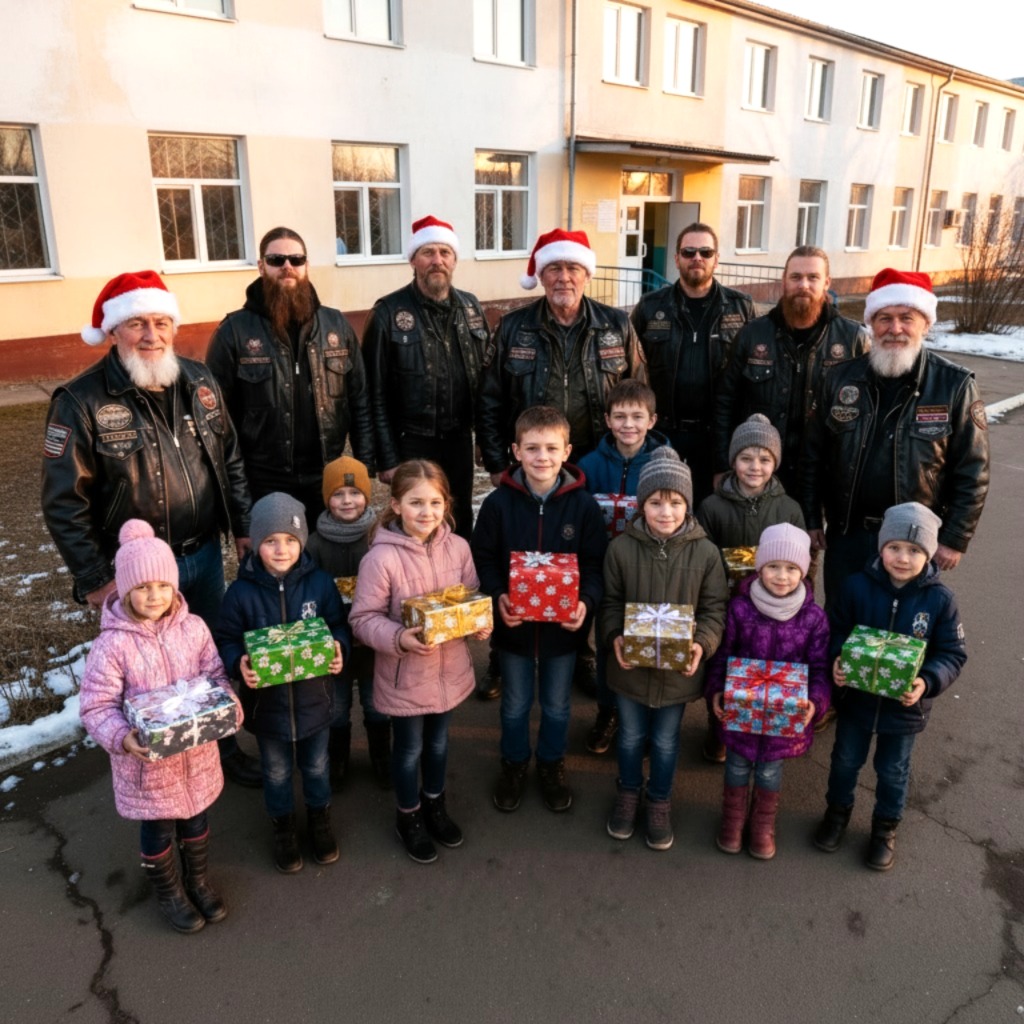
The bikers pulled into Riverside Children’s Home at six o’clock on Christmas morning, rolling up with three semi-trailers, five cargo vans, and so many wrapped gifts that they could have filled the entire gym from wall to wall.
Sister Margaret heard the sound long before she saw anything. The low, rolling thunder of motorcycle engines echoed down the quiet street, a noise that made her tense instantly. She looked outside expecting some kind of trouble — and instead, the shock made her drop her coffee mug right onto the floor. There were forty-seven bikers.
Every one of them carried armfuls of wrapped presents. At the front of the group stood a man whose leather vest read “Reaper,” and whose expression made it clear he meant business.
“We’re here for the kids,” he declared when Sister Margaret finally cracked open the door. “Every single one of them. Word got around. We heard the donations got stolen. We heard Christmas was cancelled. Well, not anymore.”
Behind him, his bikers were already unloading everything. Bicycles. Dolls. Board games. Clothes. Tablets. Notebooks. Paint sets. Sports gear. Stacks upon stacks of presents — each one labeled with the name of a specific child.
Tears filled Sister Margaret’s eyes. “How did you even know their names? How did you know what each child wanted?”
“We’ve got our methods,” Reaper replied. “Now, are you gonna let Santa’s crew come inside, or should we freeze out here?”
What Sister Margaret didn’t realize — what nobody knew yet — was that these gifts had originally been destined for a massive toy store’s holiday charity event. The bikers had “borrowed” them after discovering that the store’s owner planned to return all the toys for a tax write-off instead of giving them to kids as promised.
And in roughly four hours, the police would be arriving with a warrant. But for that moment, forty-seven bikers were about to deliver the kind of Christmas morning sixty-three children had never even dreamed of…
Forty-seven bikers had shown up at Riverside Children’s Home at six in the morning with three semi-trailers, five cargo vans, and more gifts than the gymnasium could hope to contain. I’m Father Tom Breslin, and I’ve run Riverside for twelve years. That particular Christmas morning, I was in the kitchen making coffee for the sisters, bracing for what was shaping up to be the bleakest Christmas in our center’s forty-year history.
Just three weeks earlier, our biggest sponsor — Thompson Industries — had withdrawn all support. Budget cuts, they claimed. The fifty-thousand-dollar Christmas gift budget they’d promised? Gone. The trust fund covering our heating costs? Locked down due to an unexplained legal complication. We had sixty-three kids. No presents. No holiday meal. Half the building barely heated.
Sister Margaret and I scraped together whatever we could. A few used toys from thrift shops. Some candy. Small tokens that barely amounted to anything. Nowhere close to what these children — most survivors of abuse, neglect, abandonment, or legal tragedies — deserved. Christmas was supposed to be the one day they could feel chosen.
But that year, it looked like just another reminder that they had been left behind.
Then I heard the motorcycles.
At first I assumed it was a mistake — a group going to the wrong address. Bikers didn’t visit orphanages. But the engines grew louder, closer, and then stopped right outside our door.
I looked out the window and there they were: dozens of bikers. More motorcycles than I could count. And behind them, massive trucks already opened wide.
A man stepped toward the entrance. A giant of a man — late sixties, gray beard to his chest, vest covered in patches. He knocked gently. Patiently.
Sister Margaret answered. She’s seventy, a former Marine, not easily shaken. But I saw her hand tremble where it gripped the knob.
“Can I help you?” she asked.
The man gave a warm, grandfatherly smile — totally at odds with his imposing stature. “Name’s John Sullivan. Folks call me Reaper. These are my brothers from the Iron Knights. We’re here to save Christmas.”
“Excuse me?” she said, bewildered.
“We heard what went down. Thompson Industries backing out. Kids without gifts. We’re here to fix that.”
Sister Margaret looked back at me, and I came to the door.
“How did you find out?” I asked.
Reaper adjusted the Santa hat perched on his head — yes, he was wearing one. “My daughter works at the bank. She heard about your frozen trust. She started digging, found out about Thompson pulling funding. I made some calls. Turns out plenty of people wanted to help — they just needed someone to take charge.”
Behind him, his club members were unloading box after box. Everything brand-new. Wrapped toys. Clothing. Books. Games. Supplies.
“How much does all of this cost?” I asked.
“Does it matter?”
“We can’t accept help we can’t repay.”
Reaper let out a laugh. “Father, this isn’t charity. It’s Christmas. Nobody wants you to pay us back. Just let us give these kids a day they’ll remember forever.”
At that moment, a small girl peeked from behind me. Rosie — seven years old, with us for two years after losing both parents in an accident. No extended family wanted to take her in.
She looked up at the group of bikers. She should’ve been frightened. Instead, she walked straight up to Reaper.
“Are you Santa?” she asked.
Reaper dropped to one knee — all six-foot-four of him folding down to meet her eyes. “No, sweetheart. But Santa sent us. He said he needed backup this year.”
“You look scary,” Rosie said honestly.
“I get that sometimes,” he replied.
“But you brought presents?”
“More than you can imagine. You’re Rosie, right?”
Her eyes widened. “How do you know my name?”
He pulled a wrapped box from behind him. “Because this one is yours.”
Rosie took it gently. “To Rosie. From Santa and his motorcycle helpers,” she read aloud. “What’s in it?”
“Only one way to find out.”
By now, other kids were gathering, drawn by the noise, the sight of motorcycles, and the commotion. They lined up at the doorway, staring in astonishment at the forty-seven bikers unloading Christmas for them.
Sister Margaret was outright sobbing now. “This is too much. This is—”
“This is exactly what’s needed,” Reaper said softly. “Now, how about letting us inside? We’ve got work to do.”
For the next hour, the bikers transformed the entire orphanage. They strung up lights. They put together decorations. They somehow produced a twelve-foot Christmas tree — I still don’t know where they found it — and covered it with ornaments. They laid out tables and sorted every gift by age and interest.
The kids watched in wonder. Some helped. Others simply stared at these massive, tattooed men wearing Santa hats and saying things like, “Where do you want this box of Barbies, Sister?”
By seven o’clock, everything was set. Sixty-three presents for sixty-three children. Each one tailored. Each one exactly what that child had dreamed of.
“How did you know what each child wanted?” I finally asked.
“We just asked them,” Reaper said casually.
“When?”
“Last week. We stopped by wearing regular clothes, said we represented a charity survey. We asked each kid what they hoped for this Christmas. They told us. We wrote it all down and made it happen.”
“You interviewed sixty-three children and remembered all their answers?”
“We’re bikers, Father, not fools. We wrote everything down.”
At eight o’clock, we called all the children to the gym. They arrived in pajamas, expecting the usual meager Christmas with secondhand gifts and polite disappointment.
What they walked into instead was a full-blown winter miracle — presents stacked high, sparkling decorations, and forty-seven bikers dressed like Santa’s rough-around-the-edges elves.
Little Marcus — four years old, left at a fire station — burst into tears. “Is it really Christmas?” he asked.
“It’s really Christmas,” Reaper assured him.
What followed was pure, joyful chaos. Kids tearing into their gifts. Excited shrieks. Running from biker to biker to show off what they’d received. Hugs everywhere.
Rosie got her American Girl doll — the one she had whispered about endlessly. She cradled it like treasure.
Marcus received a giant remote-control fire truck and immediately rammed it into Reaper’s boot, laughing so hard he hiccupped.
Emma — sixteen, pregnant, kicked out by her family — got a brand-new crib with bedding and a mobile. She sobbed into her hands. “For my baby? You got something for my baby?”
“Every child deserves Christmas,” Reaper told her. “Born or not yet born.”
The bikers — the big, intimidating men who society warned me about — sat cross-legged on the floor assembling toys, inserting batteries, reading instructions, comforting kids.
One biker, ironically nicknamed Tiny despite being enormous, had four kids seated on his lap, all shouting at once to show him their new treasures. He looked both overwhelmed and giddy.
“I didn’t know bikers liked kids,” Sister Margaret murmured.
“Most of us are fathers,” Reaper explained. “Some grandfathers. Some lost kids. Some grew up as the kids nobody wanted. We know what loneliness feels like. We don’t let others feel it.”
Then, at nine o’clock, everything shifted.
The doorbell rang. I opened it to find two officers and a sharply dressed man standing behind them.
“Father Breslin?” the lead officer asked. “I’m Detective Morrison. This is Mr. Gerald Thompson from Thompson Industries.”
My stomach dropped. Thompson — the man who had canceled our funding.
“Mr. Thompson reported a theft,” Morrison continued. “Three truckloads of toys taken from his company’s warehouse. We have reason to believe the items are here.”
I looked at Reaper. He stood up and walked over calmly.
“They’re here,” he said.
“You’re admitting it?” Thompson barked.
“I’m admitting those toys were intended for charity,” Reaper responded. “And this is a charity. So they’re exactly where they should be.”
Thompson stepped forward angrily. “Those toys were for our charitable auction! We were going to raise money!”
“No,” Reaper corrected. “You were planning to return them for a tax refund. I’ve got the emails to prove it. From your assistant — the one you fired for ‘losing’ donation forms.”
Thompson flushed red. “That’s private—”
“That’s fraud,” Reaper replied.
Detective Morrison turned to Thompson. “Is that accurate?”
“I… business decisions…” Thompson stuttered.
Reaper pulled out his phone and handed it over. The detective scrolled. His face darkened. Later I learned these were the emails Thompson’s fired assistant had secretly sent to Reaper’s daughter at the bank.
The detective straightened up. “Mr. Thompson, you’ll need to come with us to answer some questions.”
“But my toys—”
“These toys were given by donors for children,” Morrison said firmly. “And these are children. Seems appropriate.”
He turned to Reaper and added quietly, “We’ll sort out the technicalities later. After Christmas.”
Thompson was escorted out, ranting and threatening lawsuits as he went.
Sister Margaret clutched my sleeve. “Did we just receive stolen goods?”
“Technically,” Reaper said, “they were soon-to-be-stolen goods we rerouted to the right destination.”
“That’s… not how the law works,” she said weakly.
“Maybe not. But it’s how fairness works.”
The case against the bikers never went anywhere. Instead, Thompson Industries faced a massive investigation. Several donors stepped forward, saying their gifts were meant for children — not for corporate tax games. The assistant testified. Thompson lost his business and his reputation.
The gifts stayed right where they were.
And the bikers didn’t leave either.
They stayed through the entire day. Played with the kids. Helped make Christmas dinner — they had somehow brought enough food for a full holiday feast. They watched movies. Told stories. Made memories.
When Rosie asked Reaper, “Will you come back?” he asked her, “Do you want us to?” And when she nodded, he said, “Then we will.”
And they did.
Every single week. The Iron Knights adopted Riverside as their personal mission. They repaired our heating system, patched the roof, funded programs — but most importantly, they showed up for the kids.
Birthday parties. School plays. Graduations. Forty-seven bikers became sixty-three children’s unofficial uncles.
Emma’s baby — little Tommy — was born three months later. Reaper waited in the lobby and was the first person to hold him after Emma.
“He needs a godfather,” Emma said. “Someone strong. Someone kind. Someone who’ll protect him if I can’t.”
Reaper cried — the tough biker cried — as he held that baby.
“I’d be honored,” he managed.
Five years have passed. Riverside is thriving — fully funded, renovated, full of life. But more importantly, we have a family.
The Iron Knights still arrive every week. Still spend time with the children. Still show them that family isn’t always blood — sometimes it’s leather jackets, loud motorcycles, and men who put on Santa hats in December.
Rosie is twelve now and tells everyone she plans to be a biker someday. “The good kind,” she says. “The kind who save Christmas.”
Marcus is nine and obsessed with engines. Reaper is teaching him mechanics. “He’s a natural,” Reaper says proudly. “Kid knows engines better than some of the guys.”
Emma completed her GED, then nursing school, and now works at the local hospital. Tommy is six and calls Reaper “Pops.” The entire club treats him like royalty.
That Christmas morning changed everything — not just because of the presents, but because sixty-three abandoned children learned they weren’t abandoned. That in a world that forgot them, forty-seven bikers remembered.
Last December, Rosie asked me, “Father Tom, why did they come? Really come?”
I thought of everything I’d learned. Reaper’s daughter who died young. Bikers who had lost children or been unwanted themselves. Men judged by appearance their entire lives.
“Because they know how it feels to stand on the outside,” I said. “And they’ll never let children feel that way.”
“They’re heroes,” she whispered.
“Yes,” I said. “They are.”
This past Christmas, most of the original sixty-three kids weren’t here anymore. Forty-two were adopted. Twelve aged out and moved into supported living. Nine went to foster homes but stayed in contact.
New children arrived — fifty-one of them.
And on Christmas morning, once again, forty-seven bikers showed up with three semi-trucks, five cargo vans, and enough gifts to blanket our entire gym.
Because that’s simply who they are.
They save Christmas.
Every single year.
And they taught me something priceless: don’t judge people by what they look like. Judge them by what they do. Those bikers — the ones with leather jackets, tattoos, and roaring engines — are the kindest, most selfless people I’ve ever met.
They are Santa’s helpers.
And they ride Harleys.