The Bikers I Reported to the Police for 30 Years Were the Ones Who Showed Up When I Was Dying Alone
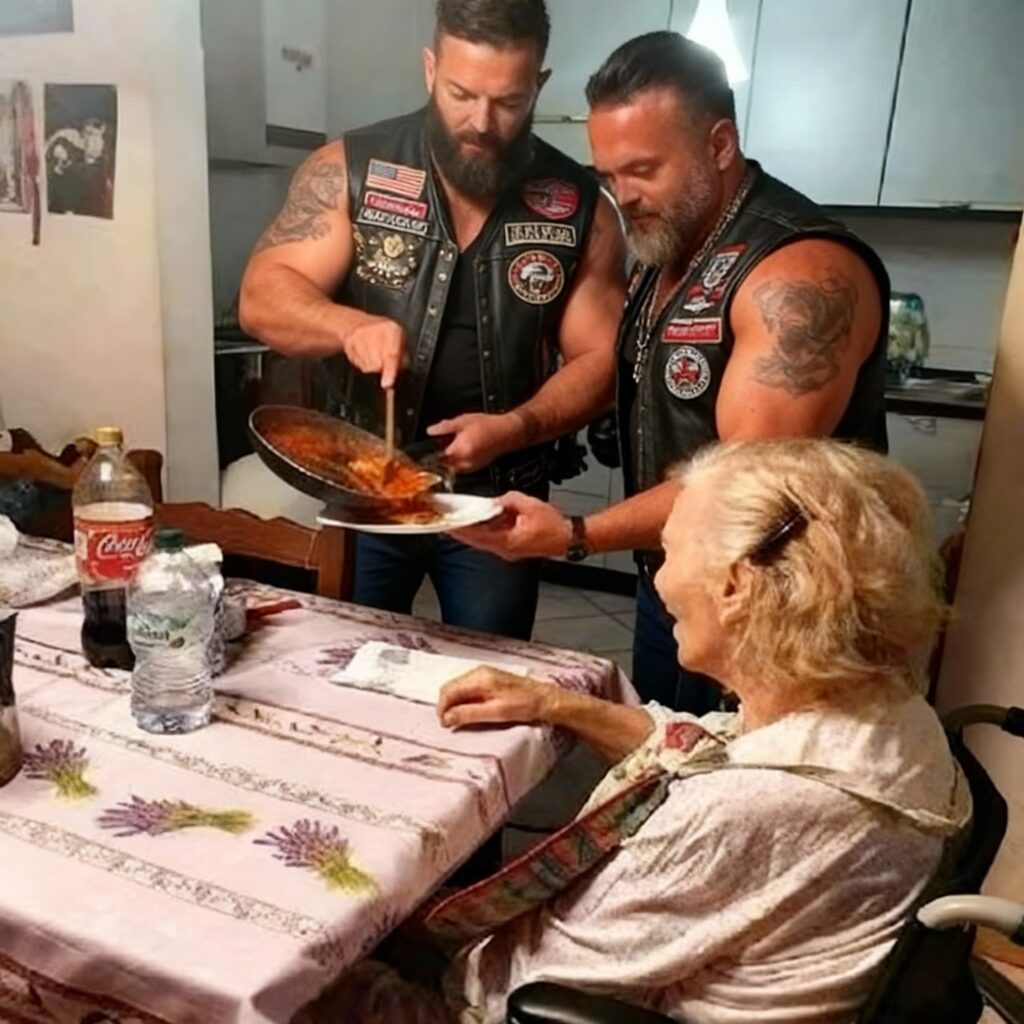
The bikers I’d spent thirty years trying to push out of the neighborhood were standing in my kitchen at seven in the morning—one of them flipping eggs in my skillet as if he’d lived there his whole life. I was seventy-nine years old, in the final stage of cancer, and I hadn’t managed a proper meal in nearly a week. The scent of bacon and warm food made my stomach come alive for the first time in days, but that wasn’t what brought tears to my eyes.
It was the way the big tattooed man with the long beard tested the temperature of my coffee before handing it to me, making sure it wouldn’t burn the sores in my mouth.
It was the way his friend quietly washed every dish in my sink, dishes that had been sitting there untouched for two weeks because I no longer had the strength to stand long enough to clean them.
It was the way they moved through my kitchen like this was routine—like tending to a dying old woman who’d hated them for decades was just part of their Tuesday schedule.
My name is Margaret Anne Hoffman. I’ve lived at 412 Maple Street for fifty-three years. I raised three children inside these walls. I mourned my husband here. And for the last three decades, I dedicated myself to trying to shut down the motorcycle club that set up shop next door, convinced they were criminals, drug runners, thugs who’d infected our quiet neighborhood.
I filed one hundred and twenty-seven noise complaints.
I called the police eighty-nine times.
I even organized a petition to have their clubhouse shut down—three hundred and forty signatures.
And yet when I reached the point where I couldn’t even climb out of bed, when my own children stopped answering their phones and the neighbors I used to chat with pretended I didn’t exist…
When I was lying in my own home, starving and fading away because I was too weak to cook and too stubborn to ask for help—
Those same bikers I’d spent years demonizing kicked in my front door and saved my life.
And the truth behind why they did it—what they’d known about me for years—shattered everything I believed.
The motorcycle club arrived in 1993. The old Henderson place had sat empty since Mrs. Henderson passed, and the property was falling apart—grass waist-high, paint peeling, windows broken. One summer morning, fifteen motorcycles rolled up the street and a group of rough-looking men in leather started unloading furniture.
I called the police immediately.
Told them a gang was invading my residential block.
The dispatcher was calm but blunt:
“Ma’am, they bought the property legally. Unless they commit an actual crime, we can’t intervene.”
They hung a wooden sign above the garage:
IRON BROTHERHOOD MC – Est. 1987
They repainted the house.
Repaired the porch.
Cleaned the yard.
But the motorcycles… every weekend, sometimes thirty of them, roaring in and out. The leather vests, the patches, the tattoos—everything about them terrified me. My neighbor Susan stood beside me one afternoon and sighed dramatically.
“Well, that’s it,” she said. “There goes the neighborhood.”
So I made it my mission to get rid of them. I documented everything—every loud engine, every gathering, every unfamiliar face. I took pictures. I wrote down license plates. I was certain they were dealing drugs or running some kind of illegal operation. After all, what normal person looked like that?
The police eventually recognized my voice.
“Mrs. Hoffman, unless you have evidence of an actual crime, we cannot dispatch officers every time someone rides a motorcycle.”
But I didn’t let up. I saw myself as Maple Street’s last line of defense.
In 1995, my daughter Linda came to visit. She pulled into my driveway and saw three bikers working on their motorcycles. She came inside trembling.
“Mom, those men next door—are they dangerous? Should you move?”
“I’ve been trying to get them kicked out for two years,” I told her. “They’re criminals, I’m sure of it. I just haven’t found proof yet.”
She never visited as often after that.
Neither did my other children.
Eventually, all three of them stopped coming altogether.
Over time, the bikers and I built an unspoken cold war. They knew I was the one making the complaints. They knew about the petition. But they never retaliated. Never confronted me. They just continued living their loud, unapologetic lives.
In 2010, the club president knocked on my door. Tall man, gray beard, arms covered in ink.
“Mrs. Hoffman,” he said kindly. “I’m Ray Jensen. I just wanted to introduce myself. Maybe try to get on better terms as neighbors.”
I kept the chain on the door and told him, “I don’t associate with your kind,” then shut the door in his face.
I felt righteous.
Smug.
Triumphant.
But I was just being a fool.
My husband passed suddenly in 2015—a heart attack while gardening. One moment alive, the next gone. After the funeral, my children returned home to their busy lives. Their calls dwindled—from weekly to monthly, then just holidays. I wandered around this house like a ghost, angry, lonely, and resentful.
The bikers kept hosting their gatherings, and each time I called the police even though I knew they wouldn’t come. Those engines revving next door—those damn motorcycles—were reminders that life was happening somewhere, just not in my house.
In 2018, I fell in my garden and broke my hip. I lay there crying for nearly twenty minutes.
And it wasn’t a neighbor who found me.
It wasn’t one of my children.
It was two bikers from next door who heard me sobbing. They knelt beside me, called an ambulance, held my hand until help arrived.
I never thanked them. I was too ashamed… too stubborn.
The injury never fully healed. I needed a walker. Grocery trips became grueling. Gardening turned impossible. I shrank into myself. My world became the inside of my home.
Then came the diagnosis: stage four pancreatic cancer.
The doctor said six months. Eight if I responded to treatment.
I told my children.
They said they were sorry.
They said they were busy.
None of them came.
Chemo tore my body apart. I’d sit through infusions alone, drive home alone, collapse into bed alone. I stopped cooking around March. The nausea was constant. I lived on crackers and ginger ale. I lost weight, energy, hope. I stopped showering out of fear I’d fall and no one would find me.
On a random Tuesday morning in April, my body finally gave out. I woke up and couldn’t get out of bed. Couldn’t even sit up. I knew I was dying.
Then I heard motorcycles outside.
Then… footsteps inside my house.
“Mrs. Hoffman?”
“Ma’am, are you here?”
Two men stood in my doorway—the same who’d helped me when I broke my hip. The younger one with soft eyes. The older one with a gray beard.
“How did you get in?” I whispered.
“Your mail’s overflowing,” the older one said. “Your paper hasn’t moved. And we… we could smell something wrong. Your door was unlocked, so we came in.”
“Get out,” I tried to say. “I don’t want you here.”
The younger one stepped closer.
“With respect, ma’am, you’re dying. And you’re alone. And we’re not leaving you like this.”
“Why?” I sobbed. “Why help me? I’ve done nothing but attack you people.”
The older man, James, sat gently on the edge of my bed.
“We know, Mrs. Hoffman. We know everything you did.”
He smiled sadly.
“But we also know you don’t have anyone else. So now you’ve got us.”
“I don’t understand,” I whispered. “Why?”
“Because my mother died alone,” James said softly. “A stranger cared for her when no one else would. I swore I’d repay that kindness for the rest of my life.”
I broke down completely.
That day, James and Bobby cleaned my house.
Gave me a warm sponge bath.
Changed my sheets.
Dressed me in clean clothes.
Fed me real food.
And stayed until I fell asleep.
The next day, more bikers came. They set up a schedule so someone would be with me every day. They cooked. Cleaned. Carried me when I couldn’t walk. Sat with me during chemo. Held my hair while I vomited. Held my hand when the pain was unbearable.
They became my family.
One day, Ray told me the truth:
“Mrs. Hoffman, we’ve been keeping an eye on you for thirty years.”
“What do you mean?”
“We saw when your husband passed. We saw when your children stopped showing up. We saw you struggle with groceries and yard work.”
He told me they’d been mowing my lawn for years—quietly, early in the mornings, so I wouldn’t know. They watered my garden. Shoveled my driveway every winter. Fixed my fence twice.
“Why would you help me?” I whispered.
“Because you were alone,” Ray said. “And because… your anger at us wasn’t really about us.”
“What was it about?”
He squeezed my hand.
“Every time you called the police, every time you complained, it was when we were having a family event. Birthday parties. Holidays. Memorials. Moments you wished you still had. You weren’t really angry at us—you were grieving.”
I sobbed uncontrollably.
In June, the cancer spread everywhere. I stopped eating. The pain became endless. The bikers increased their visits—someone was always there, day and night.
I called my children one last time.
None came.
But the bikers filled my home—twelve men in leather, their wives bringing food, their kids sitting quietly with me to keep me company.
A teenage girl, one of their daughters, held my hand and whispered, “You’re not alone anymore.”
On Tuesday, June 24th, I knew it was time. Ray sat beside me as my breathing grew thin.
“I wasted so much time,” I whispered. “Thirty years hating you.”
“You found your family in the end,” he said softly. “That’s what counts.”
James came. Bobby. Tommy. Marcus. Brothers who had become my sons.
“I love you,” I told them. “You’re my family.”
“We love you too, Margaret,” Ray said. “You’re our sister.”
I passed away at 11 AM, surrounded by the people I had once tried to destroy—men who held my hands and sang “Amazing Grace” with tear-choked voices.
My children didn’t come to my funeral.
But sixty bikers did.
They escorted my casket with roaring engines.
They held a memorial at their clubhouse—the very place I’d tried so hard to shut down.
Ray gave the eulogy, crying as he spoke of my transformation, my apologies, my final months.
They bought a burial plot next to my husband.
And on my gravestone, beneath my name, they engraved:
“Sister of Iron Brotherhood MC — She Found Her Way Home.”
My picture now hangs in their clubhouse.
I’m sitting on Ray’s Harley, wearing the vest they gave me with an “Honorary Member” patch, smiling like I hadn’t smiled in decades.
They still live next door.
They still ride.
And when new neighbors complain about the noise, they tell my story.
Most people stop complaining after that.
Because my life—my mistakes—teach a lesson:
Sometimes the people you fear are the ones who will save you.
Sometimes the family you push away is the one you need most.
And it’s never too late to put down the weight of hate you’ve carried too long.
I wasted thirty years.
But I didn’t waste my last three months.
Those months taught me what love looks like when it comes from people you never expected to care.
Rest easy, they told me.
And they still ride, watching out for those who need them—
Especially the ones who don’t know it yet.