My Child Approached the Scariest Biker and Said Something That Made Him Cry
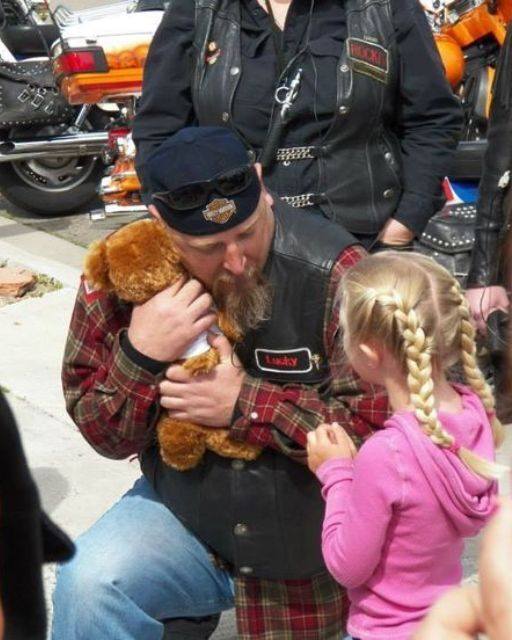
I saw a grown biker drop to his knees when my seven-year-old daughter offered him her teddy bear at a truck stop. Six-foot-four, tattooed from neck to knuckles, leather vest covered in patches—and he just broke down right there on the pavement.
My first reaction was to scoop up Emma and get her out of there. What kind of tough-looking man falls apart over a kid’s stuffed animal?
Then he pulled out his wallet with unsteady hands and showed us a worn, faded photograph, and suddenly I understood why truckers had been spotting teddy bears zip-tied to their rigs all along Interstate 80
The other bikers formed a protective circle around him, their faces grim, while my daughter stood there clutching his hand like she’d known him forever.
She’d walked right up to this mountain of a man and said six words that shattered him: “You look sad. This helps me.”
I’d only stopped for gas. Emma was in the backseat with her collection of stuffed animals, the ones she insisted on bringing for our move to Colorado.
The divorce had been hard on her, and those toys were her comfort. I’d promised we’d get ice cream at the truck stop, maybe stretch our legs before the final push to Denver.
The bikers were impossible to miss – twenty or thirty of them, their motorcycles gleaming under the harsh fluorescent lights. I’d gripped Emma’s hand tighter as we walked past, my mother’s warnings about “biker gangs” echoing in my head. But Emma had other ideas.
She’d broken free from my grasp and walked straight toward the biggest one, the one sitting alone on a concrete barrier while the others talked and laughed nearby. I’d frozen, too shocked to move, as my seven-year-old approached this intimidating stranger.
“You look sad,” she’d said, holding out her favorite bear – a worn brown thing she’d had since she was two. “This helps me when I’m sad.
But the biker….
Motorcycle culture magazine
My name is Janet Morrison, and I’m writing this because what happened next changed everything I thought I knew about making assumptions. About bikers. About grief. About the strange ways the universe sometimes puts exactly the right people in exactly the right place.
The biker – his vest said “Tank” – had stared at Emma like she was speaking a foreign language. Then his hand, easily twice the size of hers, reached out and gently took the bear. He held it like it was made of spun glass, turning it over to examine the worn fur, the missing eye, the stitched-up tear on its belly.
“What’s his name?” His voice was rough, like gravel and cigarette smoke.
“Mr. Buttons,” Emma said proudly. “I fixed his tummy myself. Mommy showed me how.”
That’s when he broke.
Not dramatically at first. Just a tremor in his shoulders, a catch in his breath. Then the tears came, silent and devastating, rolling down his weathered face into his gray beard. He slid off the barrier onto his knees, still clutching the bear, and that’s when the photo came out.
A little girl, maybe five or six, with pigtails and a gap-toothed smile. She was holding an identical brown bear, standing in front of a pink bicycle with training wheels.
“Lily,” he managed to say. “My daughter. She… she had one just like this.”
The other bikers had noticed by then, moving closer, creating a protective wall around their friend. One of them, a woman with silver hair and kind eyes, knelt beside Emma.
“Honey, that was very sweet of you,” she said softly. “Tank’s little girl went to heaven last year. She loved teddy bears too.”
Emma nodded solemnly, as if this made perfect sense. “Mr. Buttons can stay with him then. He’s good at taking care of sad people.”
I finally found my voice. “Emma, sweetie, we should—”
“No.” Tank looked up at me, his eyes red but fierce. “Please. Let me… can I talk to her? Just for a minute?”
Every maternal instinct screamed at me to grab my daughter and leave. But something in his broken expression, the careful way he held that teddy bear, made me nod.
Tank shifted and settled cross-legged on the asphalt, lowering himself to Emma’s height. “You know something, little one? I’ve been riding all over the country, leaving teddy bears for truckers to find. Lily loved trucks. Always made me pull over so she could wave at them.”
“Why do you leave bears?” Emma asked, her curiosity sincere.
“Because…” He swallowed, voice tight. “Because Lily can’t wave anymore. But maybe when a trucker finds a bear, he’ll think of his own kids. Maybe he’ll call home. Maybe he’ll slow down, pay attention.” He brushed his thumb across the worn photo. “A trucker who was texting hit her. Never even saw her on her bike.”
The silence after that was heavy. Even the constant highway noise seemed to fade away. Emma studied him with that serious, thoughtful expression kids get when something deep is sinking in.
“That’s why you’re sad,” she said. Not a question—just truth spoken aloud.
“Yeah, baby girl,” he murmured. “That’s why I’m sad.”
Emma looked from Mr. Buttons to Tank, then made a decision that still knocks the wind out of me. “Mr. Buttons wants to help you leave bears for the truckers. He’s really good at important jobs.”
Whatever composure Tank had left shattered. He pulled Emma into a gentle hug—this huge, gruff biker holding my small daughter like she was breakable crystal. “Thank you,” he whispered. “Thank you so much.”
A woman with silver hair approached me then. “I’m Carol. Tank’s been riding alone for months, stopping at truck stops and tying bears to rigs. We’ve been following at a distance to make sure he’s okay, but he won’t let us get close. This is the first time he’s said Lily’s name since the funeral.”
“I’m so sorry,” I offered, aware of how inadequate the words sounded.
“Your daughter just did more for him than six months of counseling,” Carol said softly. “Children… they see through the armor we wrap around ourselves.”
Tank finally let Emma go, wiping his face with the back of his hand. “Where are you headed?”
“Denver,” I told him. “Fresh start. New job.”
He nodded and slowly got to his feet. “Carol, radio the group. We’re escorting them to Denver.”
“Oh—you don’t have to do that—” I started, but Tank raised a hand.
“Ma’am, your little girl just gave me the first peace I’ve felt in a year. Least we can do is make sure you get there safe.” He looked down at Emma. “How about a motorcycle parade?”
Emma’s eyes lit up. “Really?”
“Really.”
And that is how I ended up driving to Denver surrounded by thirty bikers, our tiny Honda in the middle like an honored guest. Emma waved at every car that passed while Mr. Buttons rode proudly in the lead bike’s saddlebag. Tank insisted on stopping at a Walmart to buy her a new bear—“Can’t leave a little girl without her guardian”—but she chose a small stuffed motorcycle instead.
“So I remember you,” she’d explained to Tank, nearly making him cry again.
At the Colorado border, the bikers pulled into a rest stop to say goodbye. Every one of them signed Emma’s stuffed motorcycle, turning it into a quilt of names and good wishes. Tank knelt one more time, his voice steady now.
“You know what you taught me today?” he asked.
She shook her head.
“That Lily’s still here. In every good thing someone does. In every bear I leave. In little girls who aren’t afraid to help a stranger.” He pulled a small pin from his vest—a teddy bear on a motorcycle. “This was Lily’s. Will you keep it safe?”
Emma nodded, clutching it like treasure. As we got ready to leave, Tank handed me a business card. “I know today was strange and unexpected. But if you ever need anything—flat tire, bad day, someone to talk to—you call. The brotherhood looks after those who look after us.”
I looked at the card. “Lily’s Bears – Roadway Safety Through Remembrance.”
“You turned grief into something beautiful,” I told him quietly.
“Your daughter reminded me it was possible,” he said. “Sometimes we’re so lost in the dark we forget to look for the light. She was light today.”
Six months later, Emma and I were settled in Denver. The divorce finalized, the new job steady, life slowly finding its shape again. Then a package arrived—no name, just a Wyoming postmark.
Inside was a newspaper clipping: “Biker Group’s Teddy Bear Campaign Reduces Accidents Along I-80 by 30%.” The article described how Tank’s mission had grown from one grieving father to a national effort. Truckers were calling home more, driving safer—some even joining the cause.
At the bottom of the package was a handwritten note:
“Emma – Mr. Buttons has had adventures in 18 states. He’s helped leave over 1,000 bears. Truckers send photos of their kids with the ones they find. You started this. You saved lives. Lily would’ve loved you. – Tank
P.S. Tell your mom thank you. She was brave to trust a scary-looking stranger.”
There was also a photo of Tank receiving an award, Mr. Buttons displayed proudly beside him. Emma insisted we frame it.
A year later, driving I-80 to visit family for Christmas, we pulled into a Wyoming truck stop—and Emma spotted a familiar row of motorcycles.
“Mom! It’s Tank!”
Before I could react, she was out the door and running. Tank turned, heard her voice, and broke into a beaming smile. He lifted her into a hug, spinning her as the other bikers cheered.
“Mr. Buttons’ mom!” he called when he set her down. “Look at you—growing like a weed!”
The reunion was short but warm. Tank introduced us to new members, showed Emma photos of bears found on trucks, complete with messages sent in by drivers. One read: “Found this on my rig in Nevada. Called my daughter for the first time in two years. Thank you.”
As we prepared to leave, Tank pulled me aside.
“I never thanked you properly,” he said. “For trusting me. For letting Emma be… Emma.”
“She changed you,” I said.
“She saved me,” he answered. “Truth is, I’d planned to ride off a cliff. That day was supposed to be my last ride. Then this little girl offers me a teddy bear and says I look sad—and suddenly I remembered why I needed to stay. Why I needed to turn the hurt into something that mattered.”
“Tank…”
“Every bear we leave, every trucker who calls home, every accident prevented—that’s Emma’s doing. That’s Mr. Buttons’ legacy. And Lily’s.”
We stayed in touch. Emma became the informal ambassador for Lily’s Bears, speaking to schools about kindness and highway safety with a confidence born from knowing firsthand that small actions can shift lives. Tank sent updates often, always addressed to “Mr. Buttons’ Mom and Sister.”
Tank passed away during Emma’s senior year of college—a heart attack while riding. Exactly how he’d always said he wanted to go. Hundreds of bikers filled the funeral parking lot, but it was the truckers who undid me. They came in their rigs, air horns sounding a final salute, teddy bears on every grille.
Emma spoke at the service beside a blown-up picture of Tank holding Mr. Buttons.
“He showed me grief doesn’t have to stay dark,” she said through steady tears. “Love survives in what we choose to do with our pain. Every bear left on a truck, every safe drive home, every life saved—that’s love refusing to disappear.”
The organization lives on, led by Carol and the original riders. Mr. Buttons sits in a place of honor at their headquarters, preserved carefully—a symbol of how a child’s kindness can ripple outward in ways none of us could ever predict.
I still drive I-80 sometimes, and every now and then I’ll see a teddy bear zip-tied to a truck’s front grille. Each time, I think of Tank, of Lily, of all the fathers and daughters connected by heartbreak and hope—and the quiet magic that happens when we reach past fear to help someone else.
And I think of seven-year-old Emma, marching up to a biker who looked terrifying, absolutely certain her teddy bear could help him. She was right, of course. Children usually are about the things that matter. They see past the leather and tattoos to the hurt beneath, and they act—without hesitation, without calculation.
Thank God for that. Thank God for Emma. Thank God for Mr. Buttons.
And thank God for Tank—who turned unimaginable pain into purpose, who proved the toughest people often have the gentlest hearts, and who never forgot the little girl who showed him that even in the darkest places, there is always light to be found. Or shared. One teddy bear at a time.