Child Services Didn’t Want a Biker Like Me Adopting the Boy They Dumped at the Dealership
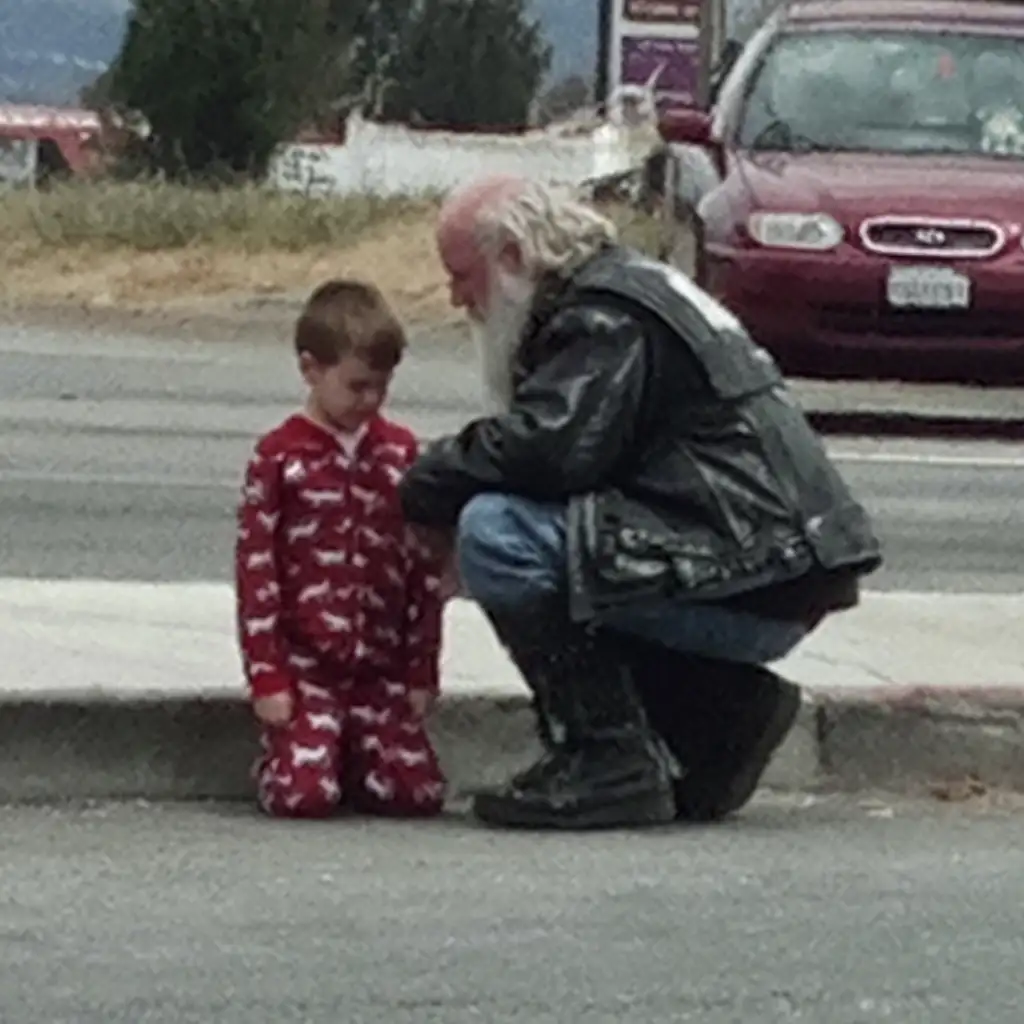
The foster parents shoved the little autistic boy out of their car right in front of the motorcycle dealership, then sped off, leaving behind nothing but a note that read, “Can’t handle him anymore.”
I was in the middle of buying new brake pads when I noticed this tiny kid in dinosaur pajamas standing alone in the parking lot. He rocked back and forth, clutching a ragged stuffed dragon, while people drifted around him like he wasn’t even there.
The dealership manager was already on the phone with the police, reporting an “abandoned child,” when the boy walked straight past everyone and went right up to my Harley. He placed his small hand on the gas tank and whispered his first words in half a year: “Pretty bike. Like dragon wings.”
Name’s Big Mike. Sixty-four years old. Been riding for forty-six of those. And nothing in all those miles prepared me for this moment. The kid wasn’t afraid of me at all—a 6’2” tattooed biker with a beard that scares grown men. He just gently ran his fingers along my bike as if he were calming a living creature, humming a tune I couldn’t place.
There was a note taped to his back. Said his name was Lucas, that he was “severely autistic and nonverbal,” and that his foster parents “couldn’t deal with his violent outbursts anymore.” But he wasn’t violent. He was terrified. And somehow, my motorcycle was the only thing keeping him steady.
I crouched down, slow and careful—the same way I’d learned to handle a delicate bike frame.
“Hey there, buddy,” I murmured. “That’s a cool dragon you’ve got.”
He didn’t look at me, but he lifted the stuffed toy. “Toothless. From movie.”
So he could talk—he just chose not to most of the time. I understood that. After Vietnam, I didn’t speak a single word for months.
The manager approached. “Sir, the police will be here soon to remove the child. You may want to move your motorcycle.”
“He’s not going anywhere,” I replied, with just enough edge to make him back up.
Lucas had begun tracing the Harley logo over and over. It was repetitive, sure—but it grounded him.
“Lucas,” I asked gently, “want to sit on the motorcycle?”
His whole body froze. Then, slowly, he lifted his eyes to mine. They were bright green, and sharp in a way most people probably overlooked.
“Really?”
“Really.”
I lifted him carefully up onto the seat. Instantly, his face lit up with pure wonder. He made a soft vroom sound, holding Toothless like he was flying alongside the bike.
That’s when child services pulled in. The social worker—Ms. Patterson—looked frazzled and done with the day before she even spoke.
“Lucas Martinez? I’m here to transport you to the emergency placement center.”
Lucas’s joy vanished. He clamped onto the handlebars and erupted into piercing screams—raw panic, not a tantrum.
“No! No! No!”
He rocked violently, and I could see exactly how people misunderstood this kid.
“Easy, Lucas,” I said, resting my hand on his back. “Breathe with me. In… out… in… out…”
And, God bless him, he followed my rhythm.
Ms. Patterson stared. “How did you do that?”
“Patience,” I said. “Something you folks seem to run short on.”
She stiffened. “Sir, I need to take the child.”
“And take him where, exactly?”
“To emergency placement. A group home.”
“His last home dumped him like garbage. Maybe the issue isn’t the kid.”
Lucas was listening—kids always listen when adults pretend they aren’t.
“Sir, I understand your concern, but—”
“I’ll take him.”
The words came out before I could question myself. But looking at him clinging to my Harley like it was the only safe place he had left? I couldn’t let him vanish into the system again.
“That’s impossible,” she snapped. “We cannot place a child with… a biker. That’s not a safe environment.”
“You get the paperwork started,” I told her. “And don’t lecture me about safety when you were about to drag him to a group home. And he stays with me until you find something better.”
“That’s not how this works.”
I pulled out my phone and called the one person who could make anything work: my daughter Jennifer, family court lawyer.
“Dad? What happened?”
“Jenny, get to Riverside Harley. Bring your briefcase.”
Twenty minutes later, she stepped out of her car and immediately assessed the situation with laser focus.
“Ms. Patterson, I’m Jennifer Reid, attorney. My client intends to file for emergency temporary custody of this child.”
“Your client just met him!”
“And has shown more ability to calm him than any placement he’s had. Lucas, buddy—would you like to stay with Mike for a while?”
Lucas nodded fast, gripping Toothless.
Three hours of calls, paperwork, and Jennifer threatening to alert the media about a child left in a dealership parking lot later, Ms. Patterson finally agreed to a 72-hour emergency placement while we filed the formal paperwork.
“You’ll need an inspection, background checks—”
“Whatever you need,” I said.
Lucas finally glanced at her. “Mike has dragon. Bike is dragon. I stay with dragons.”
She blinked, confused. But I was starting to understand him perfectly. My bike wasn’t a motorcycle to him. It was a dragon. A protector. And I was its keeper.
That night, Lucas sat at my kitchen table eating mac and cheese, narrating to Toothless about everything he saw.
“Dragon says Mike has good house. Dragon says no yelling here.”
“No yelling,” I confirmed. “Ever.”
“Dragon wants to know if Mike has more dragons.”
I grinned. “Actually, I do. Come see.”
I led him to my garage, where my vintage Indian and Gold Wing sat. His eyes widened.
“Dragon family,” he whispered.
He fell asleep on my couch, refusing the guest room but finally calm. I stayed in my recliner, keeping watch. Around 2 AM, he woke screaming about “the bad place.”
“You’re safe, buddy. You’re with the dragons.”
He settled, then asked the question that broke me.
“Why did they leave me?”
“I don’t know, son. But they were wrong.”
“Seven families,” he murmured. “Seven families didn’t want Lucas.”
Seven. At nine years old.
“Well, the dragons want you,” I told him. “And so do I.”
The next morning, I took him to meet my motorcycle club—the Road Guards, a group of veteran riders. I’d called ahead.
Twenty tough-looking bikers stood waiting, but Lucas didn’t flinch. He marched right up to Snake—the biggest of us—and said, “You have dragon pictures on your arms!”
Snake knelt. “Sure do. Wanna see the rest?”
For the next hour, Lucas wandered from biker to biker, tracing tattoos and touching bikes, completely at home.
“He’s one of us,” Bear said.
“Kid gets that bikes mean freedom,” Wolf added. “We’ll back you in court.”
Over the next weeks, while Jennifer battled the system, the Road Guards became Lucas’s tribe. He rode with me everywhere—proper gear, always. Loud noises scared him, except the thunder of engines. Those soothed him.
The home inspection was priceless. The social worker arrived to find forty bikers doing repairs, yard work, installing a security system.
“These are…?” she asked.
“My references,” I said. “All background-checked.”
She interviewed Lucas. “Do you feel safe here?”
“Dragons protect Lucas,” he said seriously. “Mike is chief dragon. Very safe.”
Then came the custody hearing. Out of nowhere, a so-called aunt appeared, claiming she wanted him.
“She only showed up for the disability money,” Jennifer whispered.
Lucas, who was supposed to wait in the hall, walked right into the courtroom.
He faced the judge.
“Seven families didn’t want Lucas,” he said, voice steady. “But Mike wants Lucas. Dragons want Lucas. Aunt Nancy only wants money.”
The judge blinked in shock. “You’re supposed to be nonverbal—”
“I’m autistic, not stupid,” Lucas said. “Different things.”
He held up Toothless. “Dragon says Mike is good dad. Aunt Nancy is bad news.”
Chaos erupted. But Lucas wasn’t done.
“Mike teaches Lucas engines. Mike never yells when Lucas rocks. Mike says different is not bad.”
Then he walked to me and hugged me—his first hug.
“Please,” he whispered. “Let Lucas stay with the dragons.”
The judge called a recess. When he returned, his voice was thick.
“In twenty years, I’ve never seen a child speak for themselves like this. Aunt’s petition denied. Emergency custody granted to Mr. Reid. Adoption proceedings to begin immediately.”
The bikers in the gallery—forty of them in leather vests—cheered.
Six months later, Lucas Reid became my son. The courthouse was packed with two hundred bikers. Lucas wore his own tiny vest: Dragon Keeper in Training.
He’s thirteen now. Still autistic. Still different. Still obsessed with motorcycles. And thriving. He can rebuild engines, has uncles in the club who adore him, and knows—really knows—that he’s wanted.
The foster parents who dumped him? Lost their license after Jennifer uncovered six other abandoned kids.
Ms. Patterson? Became one of our biggest supporters. Bought a motorcycle herself.
And me? I went from a lonely widower to a father again, part of a family bigger than anything I ever imagined.
Lucas still uses Toothless when feelings get big. Last week, the dragon “told” me, “Mike saved Lucas. But actually, Lucas saved Mike too.”
The dragon was right.
Because bikers? We’re not just a club. We’re a family that finds our people in the strangest places—even in a parking lot where a child was tossed away like junk.
But kids aren’t junk. They’re never broken. They just need someone who understands that different isn’t less.
In our world, different is home.
Always.